Tokenized Assets Regulation: US and Canada Frameworks
Reuters published an in-depth analysis of the shifting regulatory landscape for tokenized financial assets in the United States and Canada. The report tracks the transition from early experimentation to broader institutional adoption, drawing on two original indexed sources.
Veranika S

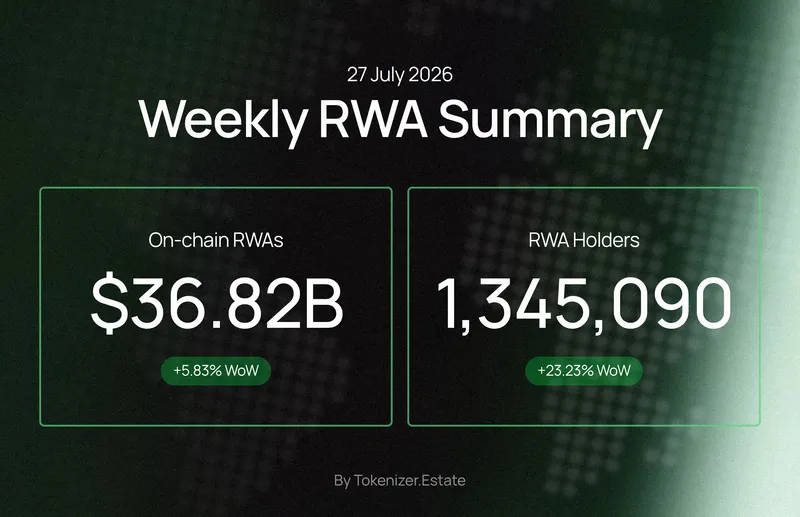
The market context underpinning both pieces is substantial. As of June 2026, non-stablecoin real-world assets on public blockchains surpassed USD $30 billion globally, with tokenized U.S. Treasuries alone accounting for more than USD $10 billion of that total. Tokenized equities remained a smaller segment, approaching approximately USD $1 billion in aggregate value in early 2026. BlackRock's USD Institutional Digital Liquidity Fund, launched in 2024, has been cited as a benchmark product increasingly deployed for collateral and cash-management purposes across both centralized and decentralized markets.
The U.S. regulatory record reviewed in the Norton Rose Fulbright analysis is notably specific. Federal banking agencies confirmed technology-neutral capital treatment for tokenized instruments. The SEC and CFTC issued a joint interpretation in March 2026 establishing a five-category asset taxonomy for tokenized securities. The SEC also approved a Nasdaq rule change in March 2026 permitting tokenized securities trading, and issued a joint statement on tokenized securities classification in January 2026. The Norton Rose Fulbright regulatory framework review characterizes these actions as a coordinated, multi-agency effort — though it notes that interoperability standards, settlement finality rules, and cross-border collateral use remain unresolved.
Internationally, the U.S. Department of the Treasury and HM Treasury jointly released a 10-point roadmap through the Transatlantic Taskforce for Markets of the Future, aimed at reducing regulatory friction for tokenized securities, stablecoins, and other digital assets operating across both countries. According to the taskforce roadmap document, the recommendations do not introduce new rules but identify areas where the SEC, CFTC, the UK's Financial Conduct Authority, and the Bank of England intend to coordinate more closely. That joint initiative, reported by CoinDesk's tokenized finance coverage, was published on July 14, 2026, two weeks before the Norton Rose Fulbright analysis appeared.
Canada's trajectory, by contrast, has been slower and structurally different. Tokenized assets in Canada are not governed by a dedicated regime; instead, they must be structured within existing securities, payments, and prudential frameworks. The Canadian Securities Administrators conducted stakeholder workshops in April and June 2026 as part of its Project Tokenization initiative, but no binding rules had been issued as of the analysis date. The Stablecoin Act (Bill C-15) received Royal Assent — along with CARF amendments to the Income Tax Act and increased FINTRAC enforcement activity — but will not come into full effect until 2027. Tetra Trust Company, via its agent CAD Digital Inc., received regulatory approval from Alberta Treasury Board and Finance to issue CADD, Canada's first CAD-backed stablecoin from a regulated financial institution.
On the prudential side, the OSFI crypto-asset capital guideline — which covers banks, bank holding companies, federally regulated trust companies, and loan companies — explicitly classifies dematerialized securities issued through distributed ledger technology as "tokenized traditional assets" within its scope. The consultation period for that guideline closed July 20, 2026; the "2027" in the guideline's path designation refers to its implementation date rather than its publication date. Both the U.S. and Canadian frameworks share a foundational principle identified in the analysis: the digital wrapper does not alter the legal rights or regulatory treatment of the underlying asset.
The Norton Rose Fulbright analysis also noted Canada's longer-standing engagement with regulated crypto products. The country approved the world's first Bitcoin ETF in February 2021, according to the Chambers Blockchain and Crypto-Assets 2026 Canada chapter, establishing an early precedent for regulated digital-asset products that has not yet been matched by equivalent specificity in the tokenized securities space.
What the Norton Rose Fulbright analysis does not establish is equally significant. It does not identify a specific tokenized real estate asset, a live issuer mandate, or a launched product in either jurisdiction that has cleared all applicable regulatory requirements end-to-end. It does not resolve outstanding questions around cross-border settlement finality, the haircut treatment of tokenized collateral in Canadian derivatives markets, or the interoperability standards that would allow tokenized instruments to move between U.S. and Canadian market infrastructure. The immediate effect of the publication is therefore a detailed mapping of where each jurisdiction currently stands — not a confirmation that either regime is complete or that institutional deployment can proceed without residual legal uncertainty in either market.