
Table of Contents
The combined market capitalization of tokenized gold crossed $6 billion in the first days of March 2026 — doubling in under six months — as a full-scale geopolitical crisis drove institutional capital into on-chain bullion at unprecedented speed.
$6 billion milestone: what the numbers show
Daily trading volumes for both Tether Gold (XAUT) and Pax Gold (PAXG) exceeded $1 billion on March 2–3, a level not previously sustained outside of single-day spikes. Physical gold was trading at $5,408 per ounce — a record driven by the escalation of the U.S.–Iran conflict and the effective closure of the Strait of Hormuz. XAUT holds approximately $3.6 billion and PAXG approximately $2.3 billion of the sector total; together they account for roughly 96.7% of the market, backed by more than 1.2 million troy ounces of physical bullion in custody.
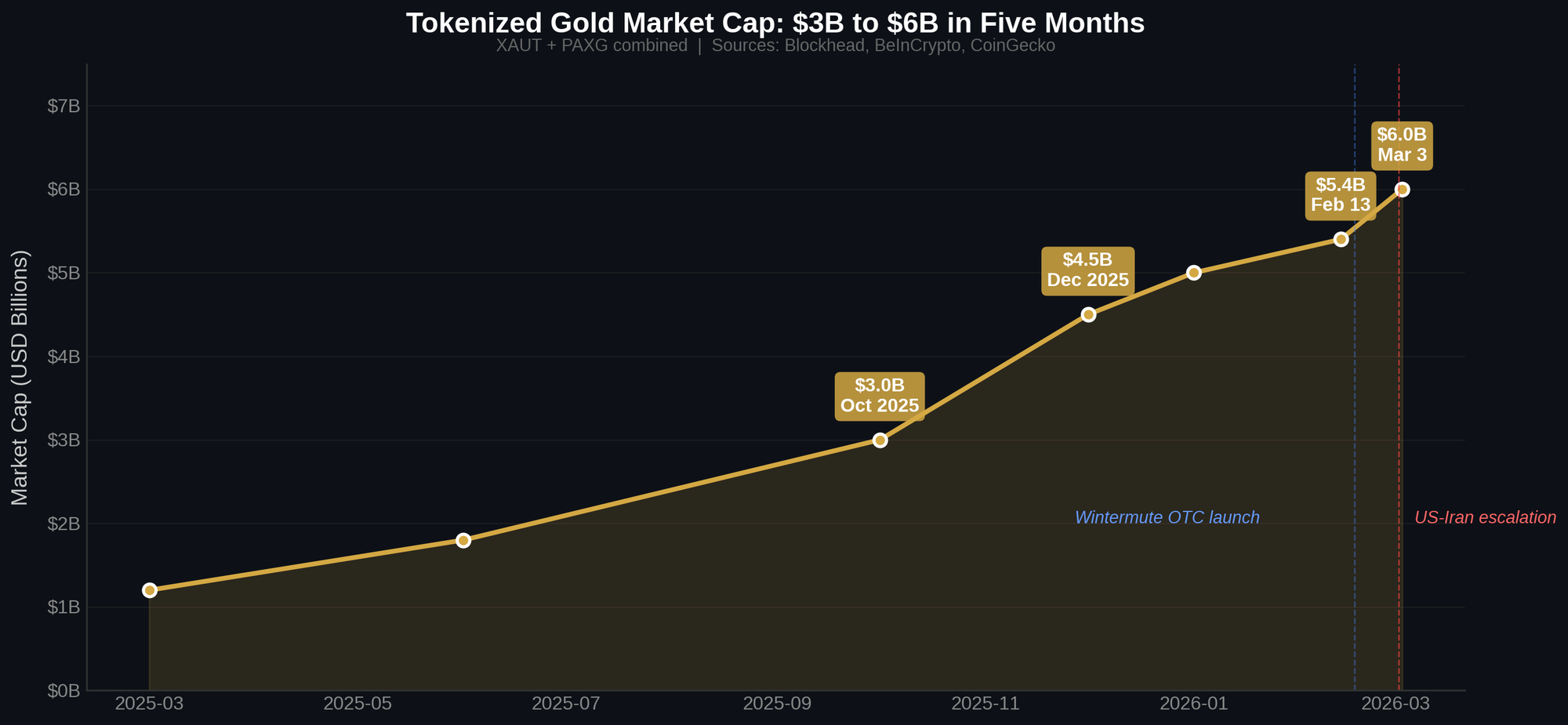
The sector hovered near $3 billion as recently as October 2025, climbed to $4.5 billion by December, and has added roughly $2 billion since January alone. In Q4 2025, tokenized gold trading volume reached $126 billion — surpassing, for the first time, the combined volume of several leading gold ETFs.
Abraxas Capital's $151 million XAUT transfer
The largest single on-chain movement in this cycle was a delivery of 28,723 XAUT tokens — approximately $151 million — from Tether's treasury to Abraxas Capital Management. The London-based firm, co-founded in 2002 by Fabio Frontini and Luca Celati, operates under FCA regulation in the UK and runs its digital asset strategies through HEKA Funds SICAV plc, a Malta-domiciled vehicle licensed by the MFSA. On-chain data from Arkham Intelligence identifies Abraxas as one of Tether's largest institutional counterparties, with assets under management exceeding $3 billion. The precise nature of the transfer — primary purchase, OTC block trade, or custodial rebalancing — has not been disclosed.
Geopolitical trigger: Iranian outflows spike 700%
Blockchain analytics firm Elliptic reported that Iranian crypto outflows surged 700% within minutes of coordinated U.S.–Israeli airstrikes, with the bulk of activity routed through Nobitex, Iran's largest crypto exchange. Nobitex processed over $500,000 in the first minutes and up to $3 million within a peak hour. Elliptic's data covers only one exchange; the full scale of Iranian outflows across all platforms remains unknown.
Institutional infrastructure catches up
A structural shift in institutional access preceded this growth. On February 17, Wintermute launched dedicated institutional OTC trading for PAXG and XAUT against fiat, stablecoins, and major crypto assets — the first algorithmically optimized OTC desk for tokenized gold at institutional scale.
The two issuers occupy distinct regulatory positions. PAXG is issued by Paxos Trust Company under New York State Department of Financial Services oversight, with the OCC having approved Paxos's application to convert to a federally regulated trust. XAUT is issued by TG Commodities Limited, a Tether subsidiary operating under El Salvador's Digital Asset Issuance Law, with quarterly attestations from BDO Italia. Institutional allocators subject to U.S. fiduciary requirements face different compliance pathways depending on which token they hold. Both tokens settle on Ethereum, but physical redemption remains available only at the London Good Delivery bar minimum — approximately 400 troy ounces, or roughly $2.1 million at current prices — limiting the redemption mechanism to institutional holders.
Who this affects
For institutional investors, on-chain gold now functions as a safe-haven instrument with sufficient depth for nine-figure transactions — a threshold crossed in practice, not theory, by the Abraxas delivery. For custodians and OTC desks, the Wintermute launch and transfers at this scale confirm that the execution infrastructure exists. For regulators, the structural concentration — two issuers controlling nearly the entire market under different jurisdictions and disclosure regimes — remains the sector's central unresolved risk.