Larry Fink: Tokenization Era Has Arrived for All Assets
BlackRock CEO Larry Fink declared that the tokenization era for all asset classes has officially begun. Fink cited large pools of idle cash as a key driver pushing investors toward on-chain investment opportunities.
Yuri Konnov

In an interview published by Forbes on June 15, 2026, BlackRock CEO Larry Fink declared that the tokenization era for every asset class has arrived, pointing to large pools of idle cash sitting outside productive investment channels as the primary economic force now driving capital onto blockchain-based infrastructure. The remarks extended a public argument Fink has been building throughout 2026, most formally in BlackRock's tokenized fund strategy coverage by CoinDesk, which detailed how the firm has framed on-chain finance as the structural successor to legacy settlement and custody systems.
Fink's central argument, as reported by Forbes, is that idle cash — held in money market instruments, short-duration deposits, and similar vehicles — represents a misallocation that programmable on-chain assets can correct by offering near-instant settlement, fractional ownership, and composability with broader digital finance systems. He named equities, bonds, and exchange-traded funds as asset classes already in transition, and argued that tokenization could reduce investment inequality by enabling access through digital wallets for investors currently excluded from institutional-grade products. KuCoin News reported Fink's investment access argument in detail, noting his framing of tokenization as a mechanism for democratizing financial participation.
BlackRock's operational footprint in tokenized markets gives the CEO's remarks institutional weight beyond commentary. The firm manages assets at a scale that makes its infrastructure choices consequential for custodians, prime brokers, and fund administrators that service it. Fink has previously compared the current moment in blockchain-based finance to the internet in 1996 — a period of foundational infrastructure build-out before mainstream commercial adoption — and the Forbes interview continued that framing. DL News reported Fink's call for the entire financial system to operate on a single common blockchain, a position that carries significant implications for interoperability standards across custodians and clearinghouses.
The regulatory environment Fink is addressing has moved materially in 2026. The CLARITY Act cleared the Senate Banking Committee in a 15-9 vote on May 14, 2026 [F — CLARITY Act Legislative Status], establishing a legislative pathway for digital asset classification in the United States. Fink has publicly called for rules covering investor protection, counterparty risk, and digital identity as prerequisites for institutional-scale deployment. FinTech Weekly's analysis of legal barriers to tokenization identified jurisdictional fragmentation and the absence of unified identity standards as the two structural constraints most cited by compliance officers evaluating on-chain product launches.
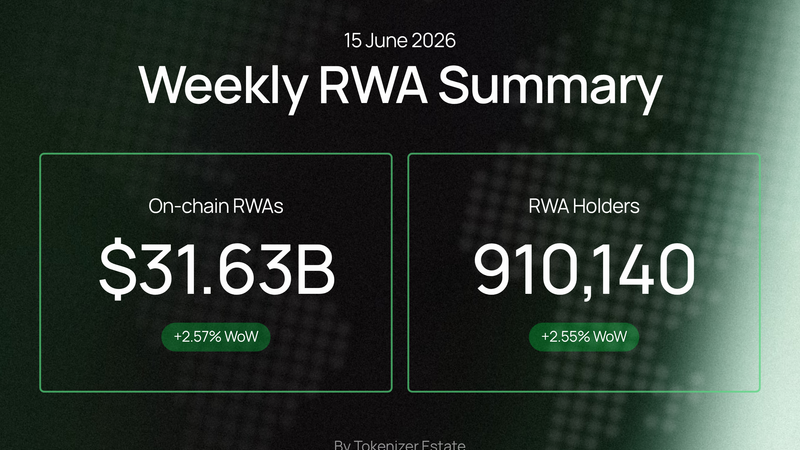
The broader tokenized real-world asset market has expanded sharply in the period leading up to Fink's Forbes remarks. Bitcoin.com News reported the RWA market capitalization at $37.5 billion, citing approximately 120 percent year-over-year growth. That expansion has been driven by tokenized government securities, private credit instruments, and money market funds — the same categories Fink cited as central to the idle-cash argument. Securitize's STAC fund, a tokenized vehicle dedicated to AAA-rated collateralized loan obligations developed in collaboration with BNY as custodian and sub-adviser through BNY Investments, represents one concrete example of the institutional product architecture Fink described, with Ethena Labs having announced a planned allocation to the fund.
Real estate has featured prominently in industry discussions of tokenization's next frontier, though Fink's Forbes remarks did not specify a named real estate product, issuer mandate, or live deployment within that asset class. The interview did not disclose which blockchain networks BlackRock is prioritizing for specific asset categories, the timeline for any new tokenized product launches, or the fee structures and minimum investment thresholds that would govern retail-accessible on-chain instruments. It also did not identify a regulatory jurisdiction in which BlackRock has received approval to offer tokenized equities or ETFs to retail investors.
The immediate concrete effect of the Forbes interview is a public CEO-level commitment, on record as of June 15, 2026, that BlackRock views tokenization as an active present-tense transition rather than a future aspiration. The interview does not establish a new product, a regulatory filing, a named institutional counterparty, or a capital commitment to any specific tokenized asset class beyond what BlackRock has already disclosed in prior filings and announcements.