Citi Forecasts $5.5T Tokenized Securities by 2030
Citi projected the tokenized securities market could reach $5.5 trillion by 2030. Stablecoins are expected to drive demand for up to $1 trillion in on-chain Treasury bills and $2.6 trillion in tokenized stocks.
Yuri Konnov

Citigroup published a report on June 1, 2026 projecting that the tokenized real-world asset market will grow from $17 billion today to $5.5 trillion by 2030, with a scenario range of $2.7 trillion to $8.2 trillion depending on the pace of institutional and retail adoption. The bank's base case, covered in detail by CoinDesk's Citi tokenization forecast, frames stablecoins as the primary demand catalyst rather than direct institutional mandates — a framing that distinguishes the report from earlier sell-side projections focused on fund tokenization alone.
The stablecoin-to-Treasury transmission mechanism sits at the center of Citi's demand model. Stablecoin issuers hold U.S. Treasuries as reserve assets, and Citi projects that growth in that reserve base will drive up to $1 trillion in on-chain U.S. Treasury bill demand by 2030. On the equity side, the bank estimates that if just 10% of U.S. retail investors migrate to digital trading platforms, demand for tokenized stocks could reach $2.6 trillion. Citi also estimates that 10% of the U.S. Treasury bill market and 3% of the U.S. stock market could be tokenized by 2030.
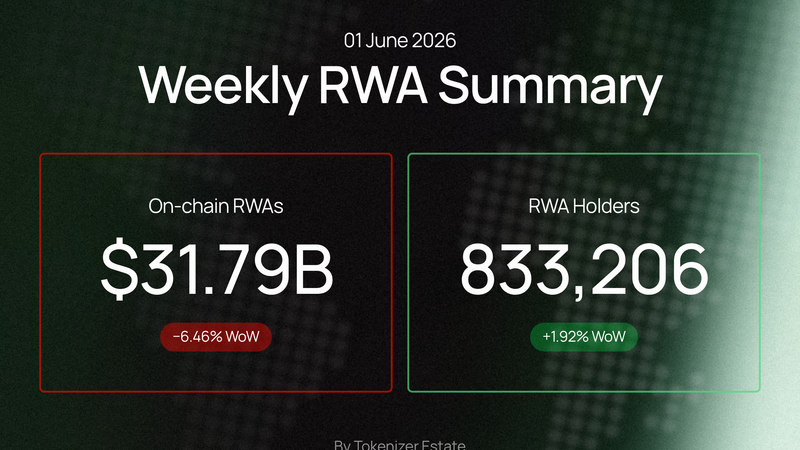
The forecast arrives against a backdrop of measurable, if still modest, on-chain growth. According to CoinGecko's 2026 RWA Report, the total tokenized RWA market capitalization rose 256.7% across fifteen months, from $5.42 billion at the start of 2025 to $19.32 billion as of March 31, 2026. That trajectory provides context for Citi's multi-trillion projections, though the bank has not disclosed whether or how it incorporates current on-chain figures into its base case.
Infrastructure timelines are beginning to align with the forecast's assumptions. In early May 2026, the Depository Trust & Clearing Corporation announced it would begin limited production trades of tokenized securities in July, with a broader platform launch scheduled for October. The DTCC's move into live production — rather than pilot or sandbox testing — marks a concrete step toward the settlement-layer standardization that Citi's projections implicitly require.
The regulatory architecture supporting on-chain settlement has also advanced. A blueprint submitted to the SEC, developed in alignment with the CFTC's Tokenized Collateral Initiative and the GENIUS Act (the Guiding and Establishing National Innovation for U.S. Stablecoins Act) regulatory framework, proposed a protocol for using tokenized U.S. Treasury bills and compliant stablecoins to enable atomic margin settlement outside banking hours. The filing party is not publicly identified in the available docket materials; its regulatory weight as a precedent therefore remains uncertain until the SEC or CFTC formally acknowledges or acts on the submission.
Citi's report does not disclose the specific methodology underlying its base-case figure, the discount rates or liquidity assumptions applied to each asset class, or the precise definition of "tokenized" used to distinguish on-chain securities from traditional digital records. It does not name the institutional counterparties, exchanges, or custodians whose adoption is assumed in the $5.5 trillion scenario, nor does it confirm that the DTCC will meet its July and October milestones without revision. The $2.6 trillion tokenized-stock figure rests on a single retail-adoption assumption — 10% of U.S. retail investors shifting to digital platforms — and the report does not model what happens to that figure if retail migration stalls or if regulatory approval for tokenized equity products is delayed in key jurisdictions.
What the report does establish concretely is a named institutional view, dated June 1, 2026, that the tokenized securities market is large enough to warrant serious capital-allocation analysis. The $5.5 trillion base case and the $1 trillion on-chain Treasury demand figure are now on record as Citi's published projections. Whether the on-chain RWA market — which stood at $19.32 billion as of March 31, 2026 — can sustain the growth rate implied by those projections over the next four years is not addressed by the report itself.